Throttle Control: What Five Driving Games Teach You About Speed
Most driving games on H5 Game Arena aren't about going as fast as possible. They are about controlling speed: knowing when to back off, when to commit, and in a couple of cases how to cope with a car you can't slow down at all. Five games cover the range well, from a hill climber where too much gas flips you over, through a pursuit game where the car never stops and a lane-change racer that accelerates on its own, to a parking puzzle with no throttle at all and an open sandbox with gears and nitro. The notes come from our own early-game play.
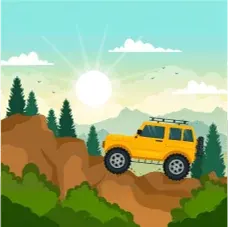
Hill Car Climb is the one where throttle control is the entire game. It is a 2D side view over rolling green hills, with a brake pedal in the bottom-left and a gas pedal in the bottom-right. Three dials sit on the HUD, Speed, Fuel (marked E to F) and Boost, alongside flag and coin counters and a progress bar toward a 500 m checkpoint marker. On a keyboard, the right arrow accelerated in our test.
The physics are where the lesson lives. The car tilts with the slope, and too much gas on a climb tips you over backwards. The answer isn't to drive slowly; it is to feather the throttle, pressing, easing off as the nose lifts, then pressing again, and to carry speed into a hill rather than trying to power up it from a standstill. In side-view climbing games like this, a light touch of brake usually brings the nose back down, which is worth trying before you reach the point of no return.
The Fuel dial makes stalling a real cost. Every time you tip over and start again, or crawl up a slope you could have taken with momentum, you burn fuel you might want later. Boost is better spent on flat ground or at the foot of a climb than halfway up a slope that is already tipping you back. Coins float above the track, and the ones you can collect without leaving the ground are usually the safer pickups. The Stage screen offers Environment 1, green countryside with a windmill, and Environment 2, a dark rocky night; the Vehicle screen has a yellow open-top buggy and a green jeep, and there is an Upgrade menu we didn't explore in depth.
Cars vs Cops flips the problem: there is no brake and no throttle at all. Your red car sits in a soft circle of light in the middle of a dark endless grid, always driving forward and leaving tyre marks behind it. The only control is a semi-transparent steering wheel at the bottom of the screen, which you drag to steer. Police cars with flashing blue lights spawn from the edges and chase you, trailing exhaust smoke.
Without speed control, your only tool is the angle of your turns. Pursuers head for where you are, so tight turns make them overshoot, and the idea is to keep turning so the chasers miss you and crash into each other. Straight lines are where you get caught. It helps to treat the steering wheel as a dial you hold at a steady angle rather than something you yank back and forth; a smooth circle is easier to hold than a series of jerks. The score sits at the top, coins in the top-right, and coins buy new cars in the shop.
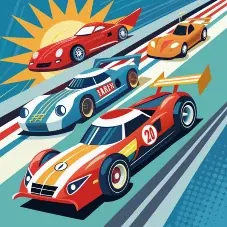
Turbo Race is another game that handles the throttle for you, but the problem is overtaking rather than escape. A pack of cartoon cars races along a banked blue track floating high above the sea, with a loop-the-loop and palm islands in the distance. Your car is yellow with black stripes. It accelerates by itself; the tutorial hand shows a left-right arrow, and you swipe or drag sideways to change lanes.
The HUD tells you what matters: a position badge (we started at POS 6th), a LEVEL progress bar ending at a chequered flag, and the rival names down the left. The goal is to finish first before the flag. Because speed is automatic, every lane change is about finding the open lane rather than braking behind a slow car, and in our run we went from sixth to second within a few seconds just by weaving past slower traffic. Orange barrels on the track punish careless weaving, so change lanes early, when you can see the gap ahead, rather than at the last moment.
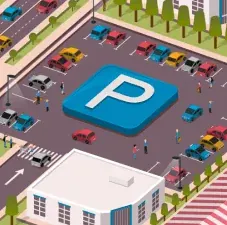
Park the Car takes the throttle away entirely and turns driving into drawing. A dark asphalt lot floats on a low-poly desert diorama with a water tower, roller-coaster rails and pine trees. On level 1 there is one pink car inside a pink outline at the bottom and a pink P bay near the top, and an animated hand shows a path being drawn from the car to its bay. Cars and bays are colour-coded, so each car has to reach the P of its own colour.
It belongs in this comparison because it teaches the same thing as the others from the opposite side: plan the line before you commit to it. With one car, any sensible line works. Later levels in games of this type usually add more cars whose paths mustn't cross, and then the order and shape of the lines become the puzzle. A useful habit is to draw the most constrained route first, the car boxed in by barriers or the bay furthest away, and fit the easier ones around it. The red restart button in the top-left clears a line that went wrong.
Extreme Car Driving is the sandbox. It is a 3D free-roam city of wide boulevards with yellow kerbs, brick apartment blocks, glass towers, palm and pine trees, and a sandy jump ramp further down the road. We didn't see a race or a timer; the point is to drive around, hit ramps and try drifts. The garage lets you flip between cars, including a red sports sedan and a red hypercar with a big rear wing, and the CUSTOMIZE panel covers wheel smoke and headlight colours.
Its HUD is the busiest of the five, so learn it before setting off: an on-screen steering wheel in the bottom-left, a nitro bottle button, left and right indicator buttons, camera-switch, hazard-light and headlight buttons in the top-left, a gear lever with D, N and R on the right, brake and gas pedals in the bottom-right, and a handbrake button for drifts. The keyboard didn't move the car in our quick test, and the car may start in neutral, so if nothing happens when you press the gas pedal, check that the gear lever is on D.
This is the one game of the five where the throttle is fully in your hands, which makes the lesson clearest. Hit a ramp flat out and you will often land badly; take it with a measured run-up and you can aim the landing. Nitro tends to be most useful on a long straight rather than on the approach to a corner. Drifting is a throttle skill as much as a steering one, too: the handbrake starts the slide, but how much gas you keep on usually decides whether it holds or turns into a spin.
Side by side, these five games cover every relationship you can have with a throttle: too much of it in Hill Car Climb, none at all in Cars vs Cops, automatic in Turbo Race, irrelevant in Park the Car and entirely yours in Extreme Car Driving. The habit that helps in all of them is looking further ahead than feels necessary, at the next slope, the next gap or the next ramp. Hill Car Climb, Turbo Race and Extreme Car Driving are landscape games and feel more natural on a wide screen, while Cars vs Cops and Park the Car are portrait and suit a phone held upright.