Reading a Puzzle Board: What Six Puzzle Games Tell You Before Your First Move
Every puzzle game puts information on the screen before you make your first move, and a lot of mistakes come from reading the wrong part of it. A tile tray, a mission panel, a timer, a pair of pictures: each one tells you what matters and what doesn't. Our earlier post, Beginner Tips for Puzzle Games: 2048, Match-3 and More, covered general habits. This one is narrower. For six puzzle games on the site, it looks at what the board actually shows you and how to read it, based on our own play of the opening levels.
Zoo Tiles looks like a pile of fruit tiles, but the important thing about the pile is its depth. Tiles are stacked in layers, mahjong-solitaire style, and only the ones on top are bright; the ones underneath stay greyed out until whatever covers them is gone. So the first read of any board is which tiles are free, and what each of them is hiding. On level 1 the fruit is only grapes, strawberries and bananas, which makes it a good place to practise looking a layer or two down before you tap.
The second thing to read is the tray. Tapping a tile doesn't clear it; it moves it into the long wooden Display Bar under the board, and only three of the same kind in that bar are eliminated. The tray has a limited number of slots, so treat it as a budget. When we sent three grapes down, they vanished at once and opened up the layer below. The habit that follows is simple: before tapping a tile, check that you can see two more of its kind that are free or about to be. A tray filling up with single tiles is the clearest warning the board gives you. Three booster slots sit under the tray, locked at the start.
Forest Match is a swap-to-match game, and the screen worth reading most carefully appears before the board does. Each level opens with a MISSION panel listing what to collect; on level 1 it was 15 acorns, 19 mushrooms and 18 blueberries. The board itself is 8 columns by 10 rows and also holds strawberries and red apples, which aren't part of that mission. That is the key reading: a big match of apples looks satisfying and does nothing for you on that level.
During play the top bar keeps a running count of what's left for each mission item, next to a countdown that started at two minutes for us. Watch those numbers more than the board. Cascades help a lot; on our first board, falling pieces had already taken the acorns from 15 down to 9 before we had done much at all. So the item with the highest remaining count is usually the one to chase on purpose while the others get picked up along the way. The three boosters under the board, a striped piece, a rainbow ball and a bomb, are best saved for whichever counter is falling slowest.
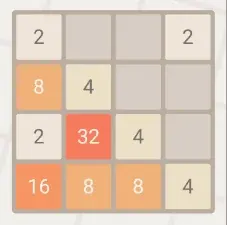
Dead 2048 uses the familiar sliding merge rule, but its board needs a different kind of reading because the tiles aren't flat numbered squares. They are zombie figures standing on coloured pads in a fenced dirt yard, seen from above in 3D, with a small plane circling overhead. Every move slides every zombie in that direction, two equal ones merge, and a new one appears after each move. You read value from the pad colour, green being the lowest, and from the figure itself, and it takes a few games before that becomes as quick as reading a number.
Two things help here. First, the yard is small, so look at what is pressed against the fence rather than what is in the middle; the edges are where blocked rows build up. Second, because a new zombie arrives after every move, a move that merges nothing still costs you a space. On desktop the arrow keys work, which makes it easy to pause, look and then commit; on a phone it is swipes. The corner habit from the earlier tips post applies here just as it does in any game of this type.
Emoji Match strips the board down to six pictures in two columns of three, and the reading is entirely about meaning. You tap a left-hand emoji, then the right-hand one it belongs with, and a correct pair gets a green outline. Level 1 had a foot, a sun and a pair of plain glasses on one side, and a red high-heel shoe, a smiling face wearing sunglasses and a disguise face with glasses, nose and moustache on the other.
That first board contains a deliberate trap: two of the right-hand pictures involve glasses. Pair the plain glasses with the sunglasses face and you are left with a sun and a disguise face that don't fit together. The better approach is to solve the obvious pair first, foot and shoe, then let elimination settle the ambiguous ones. Level 2 worked the same way, with a retro joystick, a sponge and an ear on one side against headphones, a game controller and a bathtub on the other. We didn't see a timer, so take the extra second. Each finished level shows a big green tick and a NEXT button, and adds ten coins to the counter.
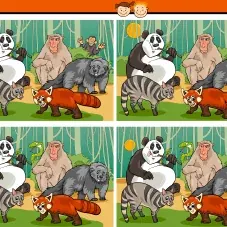
Find the Differences gives you two copies of a cartoon illustration stacked one above the other, a countdown that starts at 03:00, and a row of five purple question-mark badges, one per difference. The badges are the part people forget to read. They tell you exactly how many are left, so you always know whether to keep sweeping or to slow down for the last stubborn one. Tap a difference on either picture and a green ring marks the spot on both, while the next badge turns into a tick.
Level 1 is a dorm bedroom with bunk beds, lavender pillows, a wooden desk, an office chair, a wall bookshelf and a potted plant. The first difference, which the tutorial hand points out, is a small red book or box on the wall shelf, and that says something useful about where to look: small objects sitting among many similar ones. Rather than scanning at random, compare one object at a time across both pictures, the shelf, then the desk, then the beds. If time gets short, there is a HINT button under the pictures.
Crazy Math is the odd one out, because its board is a single sentence. An addition statement appears in a panel, such as 8+1=9 or 4+5=7, and you answer with a green V for true or a red X for false. Above the panel is a small sci-fi corridor where your character stands on the left and enemies run in from the right; each correct answer shoots the nearest one and adds a point. Hesitate and an enemy reaches you. Answer wrongly and the run ends.
What makes it a reading test rather than a maths test is how close the wrong answers are. In the early rounds we saw only single-digit addition with sums up to about eighteen, but the false statements are chosen to look right at a glance: 8+1=12 sits alongside 8+1=9. The quickest approach we found was to do the sum yourself first and then check the number shown, rather than reading the printed answer and asking whether it feels right. With roughly five to eight seconds per question at the start, there is time to add properly; the pressure comes from the approaching enemies, not from the arithmetic.
Across all six games the pattern is the same: the board tells you what a good move looks like before you make one. In Zoo Tiles it is the greyed tiles and the tray, in Forest Match the mission counters, in Dead 2048 the colour of each pad, in Emoji Match the pair that can only go one way, in Find the Differences the badge row, and in Crazy Math the sum you work out before you look. Spend the first few seconds of each level reading those, and the rest gets easier. We have only played the opening levels of each in detail, and later stages tend to add more pieces, tighter timers or harder pairings, but the reading habits carry over.