Runners and Reflex Games Compared: Six Ways to Survive the Next Second
Runners and reflex games look alike from a distance: something moves, obstacles come at you, you react. Up close they ask for quite different skills. Some are about collecting, some about timing a single button, some about reading what is coming further ahead. We played six of them side by side and compared what each one actually tests, what the screen gives you to work with, and what helped us last longer.
Cube Run is a runner where your health is your height. A runner in a red cap and blue overalls rides on top of a tower of green cubes along a purple track that stretches into the sky. Loose green cubes lie on the track; run over them and they slot in underneath, raising the tower, and we went from about two cubes to five within a few seconds. Walls of orange and yellow cubes of different heights block the way, and each one strips as many cubes from the bottom of your tower as it is tall. Reach a wall with a shorter tower than the wall, and you crash.
That makes Cube Run a collecting game first and a dodging game second. Steering is by dragging left and right, and the skill is reading the next wall's height early, then steering for enough loose cubes to clear it. A tall tower is never wasted, since the goal is to reach the end with cubes to spare. One small thing we noticed: on load it skipped us straight to level 2, so don't be surprised if you don't start at the very beginning.
Cheesy Run is a chase. A grey mouse clutching a wedge of cheese runs to the right across a desert canyon of rock spires, flat-topped acacia trees and saguaro cacti, with an orange tabby cat charging along behind. There is one control that matters, a big red up-arrow JUMP button in the bottom-right, and a red health or energy bar in the top-left with the score beneath it. A short intro cut-scene sets up the chase and can be skipped with a fast-forward button.
The obstacles we met were green cacti on the path, and the first lesson came quickly: we hit the first one and the run ended at a score of 36, bar or no bar. So treat every cactus as a run-ender until you learn otherwise. Single-button runners like this tend to reward jumping slightly early rather than late, because a late jump clips the obstacle on the way up. After a run, a game-over scroll shows your score and three wooden treasure chests to pick from as a bonus.
Climb Racer 3D turns the runner vertical and adds an opponent. It is a head-to-head race up a tall sandy-orange cliff under a blue sky with puffy clouds. You are the light-blue figure in a purple wizard hat, tagged You; the rival is a red figure with a name tag climbing the lane beside you. The wall is dotted with yellow, cyan and green holds and small dark stones marking the route, and big green boulders sit on the face before coming loose and falling.
The rival changes how you think about speed. In a solo runner you can play it safe; here, playing it too safe means losing. Climbing is a matter of tapping or holding, since a single quick tap did little in our test, so the rhythm is to keep climbing steadily while watching the boulders above you, and to dodge only when one is actually coming down your line. A glance at the rival's height now and then tells you how much time a cautious move will cost you.
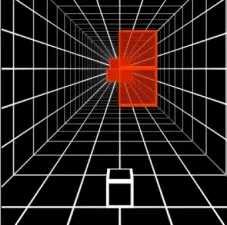
Xtrem No Brakes has the starkest look on the site: black-and-white vector lines, with a menu made of boxed tiles showing LAST SCORE and BEST SCORE around a huge outlined play triangle. In play you fly down an endless square tunnel drawn as white wireframe lines converging on a vanishing point. Your ship is a small white outlined block near the bottom, and solid red blocks rush toward you from the centre of the tunnel. As the name says, there are no brakes; speed only rises, and you dodge by moving sideways around the tunnel.
Its most useful feature is easy to miss. A small picture-in-picture preview in the top-right corner shows what is coming further down the tunnel. Most players stare at their own ship; the better habit is to glance at the preview, pick a safe line early, and move once rather than flinching at each block as it arrives. As the speed climbs, the gap between seeing a block in the main view and reaching it keeps shrinking, which makes that extra warning more valuable the longer you survive.
Jet Fire is a side-scrolling distance run with two jobs at once. Your helmeted jetpack soldier moves left to right through a forest of round cartoon trees under an orange-brown sky. The bottom-left has an up-arrow button for jetpack thrust, which you hold to rise, and the bottom-right has a crosshair button to fire. The HUD shows a portrait with a green health bar, distance in metres (ours went from 38 m to 49 m in a few seconds), a coin counter and a yellow pause button.
The hazards are floating rows of wooden logs studded with steel spikes, and coins sit in short lines at different heights. Thrust is the main skill: short, repeated presses usually hold a steady height better than one long hold, which tends to carry you too high. Because the game uses a health bar rather than one-hit failure, a single scrape isn't the end, so a coin line near a log can be worth the risk now and then. Coins go toward the shop. On a phone, use one thumb for each button; on desktop, click the on-screen buttons with the mouse.
Basketball Dunk, which calls itself DUNK A LOT on its title screen, is a reflex game with no time pressure on the individual shot, and that is what sets it apart. The ball sits in an orange hoop with a sagging net low on the screen, against a flat purple brick wall. The next hoop, a blue one, floats higher up and sometimes on the opposite side. You pull back to aim, a dotted arc shows the trajectory, and you release to shoot. Pink side walls let you bank shots.
Here the skill is reading the arc, not reacting fast. Use the dotted line fully before releasing; it is there to be used. When the next hoop is on the far side, a bank off the pink wall can be the more reliable shot than a long direct one. The menu has LEVELS and MODES buttons, so there is a level-based way to play as well as other modes to try once you are comfortable with the arc.
Lined up together, the six games test different things. Cube Run tests planning, because what you collect now decides which walls you survive. Cheesy Run tests single-button timing. Climb Racer 3D tests pace against an opponent. Xtrem No Brakes tests looking ahead. Jet Fire tests holding a height while doing something else, and Basketball Dunk tests aim more than reflex. If one of them feels frustrating, it is often because you are bringing the wrong skill to it, such as playing Xtrem No Brakes by reacting rather than anticipating, or rushing a Basketball Dunk shot.
A few habits help across the board. Restart quickly after a failed run; the first ten seconds of a new attempt teach you more than staring at a results screen. Check the HUD in short glances rather than ignoring it, because health bars, distance and score tell you whether a risk is worth taking. And if you are on desktop, the portrait games here, Cube Run, Climb Racer 3D, Xtrem No Brakes and Basketball Dunk, were built for a tall phone shape, while Cheesy Run and Jet Fire are landscape and fill a wide screen. We have only played the early part of each in detail, and later stretches tend to be faster and busier, but the core skill each game tests stays the same.